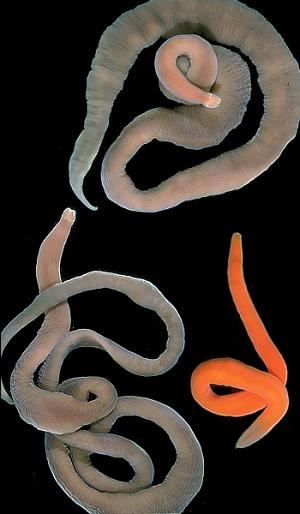
 Ribbon Worms, also known as Cerebratulus lacteus, is a phylum of invertebrate animals. This phylum is also know as Nemertea. Ribbon worms can be produced sexually or asexually and they can grow from 5 meters to 30 meters in length. Ribbon worms feed all their life and reproduce. Ribbon worms have a distinguishable proboscis that allows them to catch their prey.
Most ribbon worms are found on the seafloor while some live in different waters such as brackish water and fresh water. Ribbon worms are long, thin, unsegmented animals. They have a closed circulatory and digestive system. They have a mouth and an anus like most worms, and most ribbon worms are predatory, while some are scavengers and herbivores. They have a brain with several nerve cords, and they perform respiration by diffusion.
The earliest record of a ribbon worm was recorded in 1555 by Olaus Magnus, and he reported a long, greyish-blue marine worm which was believed to be Lineus longissimus. Also, there is a nemertean fossil called Archisymplectes. Perhaps our ribbon worms today evolved from those early nemerteans. Ribbon worms used to be called degenerate flatworms, but now they are recognized as a seperate phylum.


No comments:
Post a Comment