Wednesday, May 27, 2009

Mr. Welton


Mr. Welton,
WIthout him, this year of Marine Biology would have majorly sucked. He added about 75% of the fun to our class and i dont think that any of the teachers here at the Hyman Brand Hebrew Academy could have been as great as him. No human being will ever live up to his potential to be the best Marine Biology teacher ever. When we went on our field trips, no matter what time of the day, he would always tell his corny jokes that everyone laughed at and we all loved them. Thank you for making my year great Mr. Welton! Your the Great.

Last Week of Marine Biology...


This is the last week of marine biology class... and I'm very upset. This semester with this class was very fun and entertaining. Originally I was in Intro to Journalism, but I switched out immediately because a) I hate journalism and i knew that class wouldn't be ever so exciting and b) I'd much rather take Marine biology because it is more interesting to me. We did a lot this semester such as go to Omaha, go to pet stores, learn about all kinds of fish, watch a lot of videos, research about marine animals, and expand our knowledge on Marine Biology. I enjoyed this class and it's too bad that this class won't be offered again until 2 years. Mr. Welton was a great marine biology teacher and I can't wait till I have another elective with him. It was a fun ride, and now its over. But it was great!

Pet Store!

Last week in marine biology class, we went to a pet store that Mr. Welton's brother owns. It was really fun because we got to see a lot of cool fish and we got to see them eat. We saw an eel there, and when Mr. Welton put a fish in its tank, the eel had it swallowed within seconds. It was great. We saw all kinds of cool fish there and they were each special and unique. We also saw puppies, one of which was a cool boston terrier, and we also hamsters, furry rabbits, and rats. There were also cool parrots there and lizards, and scorpions that glow in a different color under a blacklight. there was a lot to see in there, and it was very entertaining and worth while. We also stopped at Quicktrip right before and it was very tasty. I got a hot dog, and a 32 ounce drink that was 49 cents. Overall great trip, and better than a block period at school.

Thursday, May 21, 2009

Coral Reefs

This week in marine biology class we talked about coral reefs. Coral reefs are argonite structures that are produced by living organism. A coral reef can be made up of thousands of individual organism such as polyps, and the inside of the reef is made of calcium carbonate. Coral reefs are found in shallow waters because they need a constant supply of sunlight. This sunlight is needed for the zooxanthellae who live in symbiosis with the coral reef. The coral reef provides the zooxanthellae protection and shelter, while it supplies the coral reef with nutrients and food through photosynthesis. Recently, its been getting harder for coral reefs to sustain a living because their needs aren't as plentiful as they used to be. First of all, they need to live in warm temperatures so they only live in a specific area of the ocean, near the equator. Secondly, the nutrients they need to live is shared with other organisms who take more than they should. Other factors are making a living for coral reefs harder, and soon enough it will get dangerously hard for them to live. Hopefully the continue to live, because they provide for a home to thousands of organisms.

Tuesday, May 19, 2009

It's Tuesday, May 19, and I'm watching the NBA Finals! The LA Lakers are playing the Denver Nuggets and its their first game of the series. I want the Nuggets to win because they are the underdogs and they are great. Right now in the NBA Playoffs, its gotten to the conference Finals and the other teams playing are the Cleveland Cavaliers, and the Orlando Magic. I'm expecting the Nuggets and the Cavs to play each other in the end. In other news, I have Marine Biology class tomorrow! That's exciting, and i hope some time this week we'll be going to a pet store to maybe buy some fish. Well that's all for tonight!

Monday, May 18, 2009

Nearing the end of school...

Today is Monday, May 18, 2009 and it is getting closer to the end of the school year. We get out of school on June 3rd.... that's much longer than other, normal, public schools. Technically, this is the last week of "learning" for us because after this week we start to study for our finals. Our finals are on June 1st, 2nd, and 3rd, and I'm not looking forward to it. Anyways, in marine biology class we're getting another packet and it's about coral reefs. I will make another blog about that soon, so be expecting that... Oh yeah, we have no school next Monday and Friday because its Memorial Day and Shavuot. Looking forward to that!

Wednesday, May 13, 2009

Chapter 9 Packet

This week in Marine Biology class we got a packet about marine reptiles, birds, and mammals. Vertebrates have invaded land 350 million years ago. Land vertebrates descended from bony fishes. The land vertebrates had to live on land meaning they had to breath air, and they evolved from fishes who had lungs for breathing. Reptiles today have evolved from now-extinct amphibians. There are 7,000 living species of reptiles, including lizards, snakes, turtles, and crocodiles. Their dry skin is covered with scales to prevent water loss. Most reptiles are ectothermic, commonly called "cold-blooded." Reptiles first appeared more than 300 million years ago, and several species have adapted to the sea. Birds have advantages over reptiles such as the ability of flight. Birds are endothermic, which is referred to as "warm-blooded." This allows them to live in a wide variety of environments. They have waterproof feathers that conserve body heat, and their flight is made easier by their light, hollow bones. Marine mammals evolved about 200 million years ago. They evolved from now-extinct reptiles, and they are air-breathing and warm-blooded. Their skin has hair instead of feathers to retain body heat. They are viviparous meaning the embryo receives nutrients and oxygen through the placenta. a new-born is fed by milk secreted by the mother's mammary glands. Their young are well-cared for. All these 3 types of animals have adapted and evolved from extinct animal groups millions and millions of years ago.

Tuesday, May 12, 2009

Sea Otter PowerPoint assignment

Two weeks ago our teacher assigned us an assignment that was to make a PowerPoint about an article online that was about a marine animal. We had to find this article, read it over, and make a slide show about its concepts, information, and we also had to critique it. My slide show was about sea otters and what the causes of their deaths were. The article I used was called What's Killing the Sea Otter by Dan Cray. What I found out is that there has been a significant decline in the population of sea otters because of several factors. These include shark bites, bullets, boats, and a pair of protozoan parasites named Toxoplasm gondii, and Sarcocystis neurona. These parasites get to the sea otters via the sea, and they come from cat litter being flushed down toilets and poured into storm drains. If this continues to happen and the same rate, the sea otter population could suffer drastically and they could become more than an endangered species...

Friday, May 1, 2009

This week....

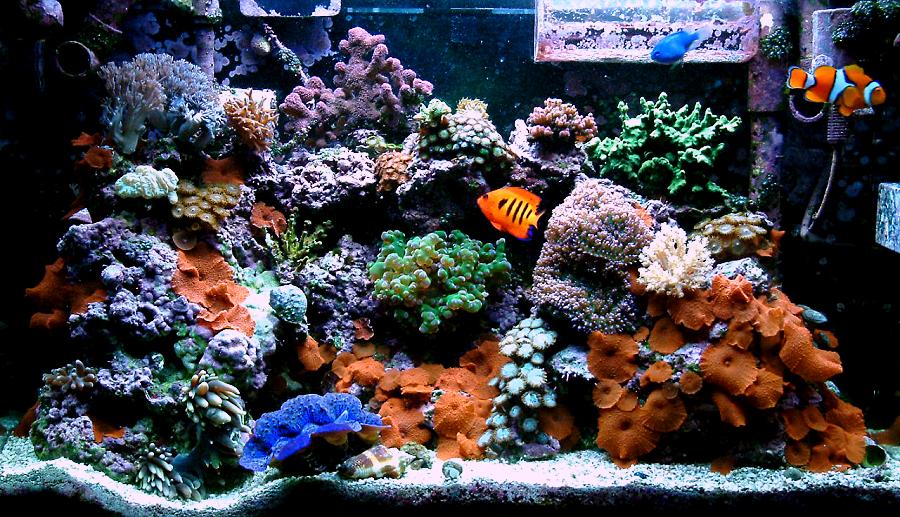
This week in Marine Biology class, we did more work on our tanks. So far we have the water in the tanks, some corals, sand, and some of them have sponge filters in them already. My tank doesn't have a filter yet, but soon it will. We don't know when we're going to go out and buy some fish or something, but i hope we will soon. Mr. Welton, our teacher, assigned us a PowerPoint assignment where we have to find an article about a marine fish, and then make a slide show that criticizes it, analyzes it, and summarizes it. I'm not sure what my topic is going to be yet, but I'll find one soon enough.

Monday, April 27, 2009

Our Tanks

In marine biology class, we got pretty far on our tanks. So far we've filled it up with saltwater, put in sand, and put in corals to our liking. Hopefully, soon we will get some type of organism put in them, and get the filter running for the tank. From now on, every day we meet in class we will test our tanks for pH, nitrite, and ammonia. Our ideal values for each test respectively is 8.2, 0, and 0. If our tanks fulfill those values, then they are susceptible for a saltwater organism to live in. I'm looking forward to getting a fish or some type of living thing in my tank, and when i do, it'll be cool.

Monday, April 20, 2009

Omaha Field Trip


On the 6th of April, me and my marine biology class went to the Omaha Zoo. We had to leave our school at 6 a.m. and we had to make a 3 hour drive to Omaha. We got there at 9 a.m. and we entered the zoo at 9:30 for a behind the scenes tour of the aquarium. The aquarium was the first thing we saw and it was really cool. We saw penguins, sharks, manta rays, octopi, jellyfish, polyps, corals, turtles, and lots of fish. Later on, we saw the aquarium behind the scenes. We saw where they feed the fish, how they do it, we saw all the equipment needed to host all the marine animals, we saw the filtration systems, and each tank is set up uniquely to comfort the animals.

After seeing the aquarium, we had time to do whatever we want, so we looked through most of the zoo. We saw all types of animals. We went to the monkey house and we saw monkeys, orangutans, gorillas, and squirrel monkeys. Then we went to the rain forest, where it was a big house that imitated a rain forest, with a whole bunch of animals. There were snakes, lizards, tapirs, hippos, birds, monkeys, and fish. It was moist and humid in there, and it was like being in a real rain forest. After that we went to the dome. The dome was an imitation of the desert, with a whole bunch of animals and plants. There were cacti, and plenty of desert animals like bearded dragons, hummingbirds, and lizards. Everything I saw was so cool and entertaining. I had a great time and I thing it was worth my time.

Monday, March 30, 2009

Ribbon Worms

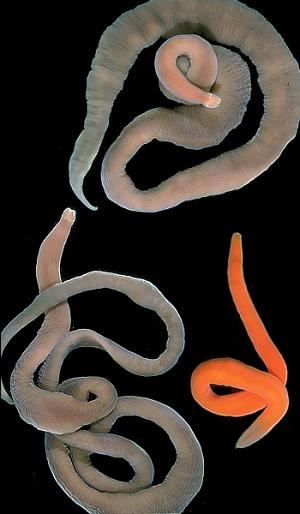
Ribbon Worms, also known as Cerebratulus lacteus, is a phylum of invertebrate animals. This phylum is also know as Nemertea. Ribbon worms can be produced sexually or asexually and they can grow from 5 meters to 30 meters in length. Ribbon worms feed all their life and reproduce. Ribbon worms have a distinguishable proboscis that allows them to catch their prey.

Most ribbon worms are found on the seafloor while some live in different waters such as brackish water and fresh water. Ribbon worms are long, thin, unsegmented animals. They have a closed circulatory and digestive system. They have a mouth and an anus like most worms, and most ribbon worms are predatory, while some are scavengers and herbivores. They have a brain with several nerve cords, and they perform respiration by diffusion.

The earliest record of a ribbon worm was recorded in 1555 by Olaus Magnus, and he reported a long, greyish-blue marine worm which was believed to be Lineus longissimus. Also, there is a nemertean fossil called Archisymplectes. Perhaps our ribbon worms today evolved from those early nemerteans. Ribbon worms used to be called degenerate flatworms, but now they are recognized as a seperate phylum.


Sunday, March 29, 2009

Tube Worms

So I was watching the discovery channel and it was a show about the deep sea. It got to a section about tube worms and it said they were one of the oldest living marine animals on earth. Tube worms can live for a period of time. Tube worms can grow up to 2.4 meters in length. It takes about 175 to 200 years for them to grow at least 2 meters. Some tube worms live for much much longer than that. Tube worm colonies can live for about 1000 years but an individual can't. Tube worms can tolerate extremely high temperatures and sulfur levels. They are found near black smokers and that is how they feed, but they have no digestive tract. Tube worms have a symbiotic relationship with bacteria that perform chemosynthesis. These bacteria live within specific organs of the tube worm and they make up a good amount of the tube worm's weight. The tube worm's red plume- organ used to exchange compounds with the environment- provides the bacteria with nutrients, and the bacteria perform chemosynthesis and allow the tube worms to feed.

Friday, February 27, 2009

Algae

Algae are a large and diverse group of autotrophic organisms. Algae can be unicellular or multicellular but the largest and most complex marine type is seaweed. Algae can come in a variety of sizes, shapes, colors, and have different functions. Algae are helpful to our world because they are photosynthetic and they produce a large amount of oxygen in our atmosphere. Some algae can also control pollution and that can be very helpful. Algae are everywhere in our world and they take role in many different ways in their environment. Hopefully they will continue to exist and be primary producers.

Friday, February 20, 2009

Chemosynthetic Bacteria

Chemosynthetic bacteria are bacteria that make food through chemosynthesis. Chemosynthesis is a process that converts carbon molecules and nutrients into organic matter by oxidizing inorganic molecules. Chemosynthesis takes carbon dioxide, water, hydrogen sulfide, and oxygen to make formaldehyde and sulphuric acid. By this process, these chemosynthetic bacteria don't need any sunlight to make energy. Chemosynthetic bacteria are one of the oldest life forms on Earth and most are found near the hydrothermal vents deep underwater. These microbes are relatively important to the hydrothermal vent community because without them, the vent organisms could not get any food and they would die. Without these chemosynthetic bacteria, there would be no organisms near hydrothermal vents and there wouldn't be a chemosynthetic cycle.

Tuesday, February 10, 2009

Week 4 in marine biology.


This week in marine biology class, we talked about the basics of biology. We talked about carbohydrates, the building blocks of life, and the structures of some important molecules. We talked about the cell, some of its organelles, photosynthesis, respiration, diffusion, osmosis, and much more. On Monday, we wrote a page essay on one of the questions in our chapter 4 reading. Last week, we got our own 20 gallon tanks and we can put whatever we can fit in them. I'm not sure what I want to put in my tank yet, but I do know that I want it to be a cool looking fish.

Saturday, January 31, 2009

Chemical and physical properties of sea water

This week in marine biology class, we talked about water and its physical and chemical properties. We learned that water is most dense at cold temperatures, and that cold air sinks and hot air rises. Air pressure is higher at lower sea levels, and when the pressure is strong enough, it could kill. When water condensates, energy is released, and when water evaporates, energy is being absorbed. A water molecule has a positive hydrogen end, and a negative oxygen end. Since the oxygen molecule is stronger and has more electrons, it pulls all the electrons towards it making the water molecule polar because the share of electrons is uneven. Sea water has many other components in it like salt and other elements so sea water has a salinity level. Sea waters get either heated or cooled depending on the type of wind that flows by it. Different winds carry water and air to different areas at different temperatures making all sea water different in some way.

Sunday, January 25, 2009

The Sea Floor

This week in Marine Biology class, we learned about the sea floor and other things related to the sea floor. The sea floor is made of basalt, and the continental crust is made of granite. I learned about continental drift, which is a theory that all of the continents used to be linked together because each continent moves very slowly each year. Alfred Wegener came up with this theory but no one believed him. When all of the continents were together, it formed a super continent called Pangaea. I also learned about divergent, convergent, and transform boundaries that occur between tectonic plates. Each different boundary causes a different thing, either an earthquake, a volcano, or a new piece of land. On Earth, there is 71% water and only 29% land. There is a vast amount of sea floor to explore and it will be a long time until mankind knows all about it.